Monday, November 30, 2009

Iglesia


I studied abroad in Costa Rica two summers ago. For the first two weeks I stayed with a host family in Grecia, which is a small town right outside of San Jose. When we arrived at our school there we walked around and this church was right in the middle of town; which was extremely helpful because if we ever got lost we knew exactly where to go because you could see the church from anywhere. It was bigger than any of the buildings because most of them are only one or two stories max. When I met my host family in their house and visited other friends houses, the decorations in all of the houses were very minimal. And for the most part if there were any decorations, it was usually some religious statue, a bible, or a picture of GOD. There were also other churches within the town that were located fairly close together. Every Sunday churchs' would have services and be lined out the door and people would still be participating even if they were standing outside in the street of the church because they could still see and hear what was going on. This particular church or in spanish "Iglesia" was in the middle of town and the center of attention. It is open from 6 am to 8pm and you can go in and out of it everyday, but you cannot take pictures inside. Religion and God are the center of the people in Costa Rica's lives, especially in Grecia. Before every meal we prayed with my host family, at school, as well as before we went to bed. Having very strong religious beliefs is extremely important to this town, and the Iglesia is an architectural representation that portrays how much religion is a central part of the people of this town.

Amanda DeSalme-Drum Circle


I know it's been a little while since we did the drum circle at the Lion's Bridge, but I wanted to write a little bit about the experience. It was the perfect day for it. I got swept up in the beauty of the whole experience. At one point while we were drumming I looked up and the sun was setting on top of the water. It was gorgeous. It was as if I was more in touch with my surroundings by performing this ritual. I noticed flocks of birds flying above us; I felt the cold solid earth beneathe my bare feet. The music was like a conversation between all of us in that circle without words. Rhythms played off of eachother and complimented each other and so did the tonal instruments. I felt very moved and in general just more aware of the moment. My senses were brimming with an altertness that I do not employ in my everyday life. I think sometimes we get bogged down with routines of classes and work and things to do that we forget to enjoy every aspect of whatever it is we are doing. It takes events like this to wake us up and jostle our awareness of our senses back to life. We are constantly seeing, smelling, feeling, hearing things but our brains tend to block a lot of it out. When you embrace all of your senses it is invigorating and refreshing. I wonder why I am not that aware everyday of my life. I think another moving part was near the end of the drumming, when we all started to use our voices, still without words...but it felt so good to just shout out a primal explanation. And we all shouted together which made us all feel so unified in the experience. It was really wonderful and definitely spiritual. I can see now why people can really get into things like drum circles. It made it seem even more sacred with the ritual of walking around the circle before and afterwards, signifying the power of the experience we were about to or just had partaken of. improvised music is a powerful way to access something spiritual. I think that is why I gravitate towards jazz a lot as a musician, because improvisation is so freeing and a great way to be creative and connected with the other musicians you are playing with and aware of the moment and what your body can do with that moment. Improvisation has got to be one of my favorite kinds of music. Just because of the state of awareness that you have to be in to make anything out of it. This has been a post full of run-on sentences and babbling so I hope it could be understood, I kind of just needed to blurt out all of the things I felt and thought about it. so, hurray for senses and awareness connecting us to the wholly other! hurray for drum circles! :)

Sunday, November 29, 2009

Peruvian Majesty- rebecca hagen


Last Decemeber, I went to Peru for two weeks. I was the most amazing time of my entire life and I would return there any day to live for all time. The whole country is absolutely magical. Driving up to Aguascaliente at the base of Machu Picchu, one is surrounded by clouds, almost raising up into the heavens itself. Looking down at the ancient city complex, is breathtaking. All around you are mountain peaks covered in green and random grazing llamas. It is almost unreal. Looking back in pictures I have of my in front of the monument, it looks fake. It seems as if I am posed in front of a green screen, so perfect and beautiful is the destination.
Every second of the trip was breathtaking. Simply taking the train to Cusco, he followed a roaring river and went right through mountains and tiny villages. Our next stop however was the jungle of Lake Sandoval. We stayed in the jungle for days. Living in little huts with bug nets around our matresses and power for only one hour a day. The simplicity of it all was amazing. During the day we would go out for hours of walks and hikes, took canoes out on the lake to look for giant otters and searched for monkeys, toucans, and macaws. During the night, we went out in search of caymans and tarantulas. The ability to see such animals in their natural habitats was insane. Simply walking down a pathway to the main house, a monkey was hanging out of the trees ten feet over my head.
Our last major stop on the trip was the desert. Ever since I was young, I always wanted to see the Nazca Lines, drawings in the sand thought to be created by ancient, indigenous people in the area. The drawings include lines, designs, monkeys, birds, hands, people, and more. All gigantic figures that can only be seen from the sky, which begs experts to wonder who they were trying to reach out to. The gods? or aliens? The theories are quite diverse. I have a fear a flying. The smaller the plane the worse it is. But, my desire to see the lines was so great, that I actually went up in a six-person Cessna in a small town in a third world country without a second thought. (Also having read before the trip that there were numerous deaths of tourists from plane crashes every year in the area). There was no other option but to go and I am so glad that I did. The trip was absolutely amazing and it positively change my life forever. I hope to go on more exotic adventures soon.

Devils Tower- rebecca hagen


11/4
In doing research for my presentation for class, I was surprised by how many varying stories I found surrounding the creation of Devils Tower in Wyoming.
Although they were all different, they all focused on the importance of spirituality in nature. In one legend the tower instantly rose up when the Great Spirit noticed they were in peril and felt the need to protect them. In another, little girls prayed to the rock to save them and it instantly began raising into the air. All the stories are like this, with different people being chased by a bear and either the Great Spirit that American Indians saw as the main god of the earth, or the spirit of the earth itself saved them. Their dedication and faith in nature and spirits resulted in their salvation.
I was young when I went to Devils Tower, probably about six. However, I remember the awe I felt standing in front of such a structure. I was so curious as to how to was created; why it had the columns and why it raised out of the ground straight like it did. In doing this research, I finally have my answers. The actual structure is thought to either be a volcanic neck or a monolithic igneous intrusion. A volcanic neck is created by the cooling of magma within the neck of the volcano. Through erosion (wind and rain) the outer shell would have fallen off, leaving us with the structure we see today: pure cooled magnum. If it is an igneous intrusion, than there was magma that began pushing up underneath the earth's crust, but never broke through, creating a bump underneath the earth.
Although there are scientific answers today to the creation of the monolith, the legends are and will always be most intriguing. The fact that many tribes from all different areas of the continent holds these myths gives strength to their argument. I find it extremely intriguing to learn about such legends and see the importance of their beliefs, those in the Great Spirit or in the spirit of all nature.

Animism v. Totemism- rebecca hagen

10/10
I have recently been reading out of a book on religion that I found in my dad's house library. It's main focus is on the origin of religion. Presenting the arguments for many different possibilities. The two relgiions that I believe may be the origin of religion are animism and totemism.
I think that the most primal form of religion is Animism. In his article, “From Primitive Culture”, Edward B. Tylor describes Animism as simply belief in a spiritual being, the main theme being the eternal human soul. It is also seen as the origin of all religions by Tylor, as it travels from primitive man to civilized man. James George Frazer in his excerpt from “The Golden Bough: A Study of Magic and Religion and Totemism and Exogamy” states that religion has to contain a superior force that can not directly be viewed in nature. Animism is a more basic form of religion as we know it today. Participants went from treating everything in this world like a spirit with a soul, but then moved on to treating some as actual deities to worship.
However, Animism focuses mainly just on the soul and almost totally ignores the physical world and the scientific realm. The belief system has gone from believing in souls of animals, plants, etc. to primarily just human ones.
Frazer asserts that belief systems seen as Totemism and Magic came before modern day religion. Totemism is a belief in individual, sex, or clan totems which are animals and other naturalistic objects that represent the person, group, etc. spiritually. Totemists have the ability to think in analogical thoughts regarding spirituality, but because of this cannot think very logically or scientifically.
Frazer also believes that magic preceded religion. Those who believed in magic believed in the order and consistency of nature. Very cause and effect oriented with the same spells always doing the same thing. However, like Totemism, Magical thinkers again are limited in there thought processes, not being able to think in mathematical, scientific ways. Although those who practice Magic think they are causing something to happen, this is misleading and instead it was simply a correlation of things.
If I could break it down, I think the most primal form of religion would have to be the worship of nature. The earliest human beings, although perhaps not having the full mental capacity we have today, would have to be in awe of the world surrounding them. Without knowing the scientific reasoning behind it or any other logically thinking, they would be totally amazed by the phenomenon happening around them, with the revolving sun, changing of seasons, storms, etc. I personally find it fascinating today and I think the experience would be much more intense long ago.

Appalachian Trail Adventure- rebecca hagen


9/7
Zolton visited us today. I think it is amazing the kind of dedication such an adventure must take, hiking the entire Appalachian Trail. Georgia to Maine. 2175 miles. Having read "A Walk in the Woods: Rediscovering America on the Appalachian Trail", by Bill Bryson, my interest has been peaked since sophomore year or college. I have looked into the strenuous trek. I have always looked at things through rather transcendental eyes. I can only imagine the types of thoughts and feelings this experience must stir up. It is truly amazing when an individual can rise above physical things such as pain, hunger, etc. and can spend months just living out in the wild.
I would love to just do that. Strip myself of all monetary items and connections to society in order to fully give myself over to nature and simple living. However, I feel it difficult to mentally rise above some of these things. I don't believe that I am quite ready for the adventure. Although I enjoy solitude, especially in nature, I consider myself a social person. I get almost depressed if alone too long. Like Chris McCandless eventually discovered, I believe that happiness is only real when shared. I would need a compadre at least part of the time to really enjoy my time with nature, which I find regularly to inspire awe and a moment of quiet enlightenment.
"I experience a period of frightening clarity in those moments when nature is so beautiful."
"The richness I achieve comes from Nature, the source of my inspiration."

rebecca hagen- Art as Escapism


9/2
How art sparks desire for something more than everyday.
Life memories, art allows one to get lost in their fantasies. The images, structures, etc. allow the viewer to get a glimpse into another facet of another life; something they have not experienced and long to do so. One can get lost in hopes and dreams and other possibilities.
Personally, I am drawn to images of water. I love all water, whether it be the ocean, lakes, rivers, or creeks, and I hope to always be surrounded by them. I was born and raised in a suburb of Minneapolis, Minnesota, land of 10,000 lakes. My entire life has been spent living on a large pond, having a cabin on the enormous Lake Superior, and going to school in the Cities directly on the Mississippi River. I love just sitting by the water, boating, doing water sports; anything that involves the water.
Paintings that revolve around the sea particularly grab my interest. Impressionist artists like Claude Monet or Romantic painters of the 18th century. I am drawn to the way the light reflects on the water, the life out there, and even man made creations such as boats. The way color and light interacts is truly amazing.

Tuesday, November 24, 2009

Van Der Leeuw on Drama - Kevin Gontkovic

For this post, I’d like to talk about Van Der Leeuw’s view on drama in his book, Sacred and Profane Beauty. Van Der Leeuw speaks of a mask that the actors have to wear when they go on stage. He says, “Through the mask one is transformed into a person in the sense of an actual, essential happening” (84). The actor is transformed into the character that he or she is portraying. They become that person in the story and lose themselves in the process. By doing so, the actor is able to make the story into an actual occurrence. The story is actually able to happen in this world through the actor becoming one with his or her character.

According to Van der Leeuw, “actors are ‘only a symbol of a world outside the usual world’” (Leeuw 84). By putting on the mask that transforms them into another person, the actors are able to become a symbol of the world of the story. By giving themselves up to a higher power they are able to open a pathway to this other world that is outside our own. They let the character from this other world take over their body. The actor is not in control of his or her own body. He or she must let this person from the other world take over his or her body.

Van der Leeuw says, “As long as the mask is consciously worn, the role played, the action of the actor means little as art, and nothing at all in the religious sense” (Leeuw 105). In order for their performance to be religious, the actors must not be conscious of what they are doing. They must give up their body to the character. The character from the other world must have complete control over the actor’s body. Once the mask is put on, the actor must lose his own consciousness and the consciousness of the character must then take over. If the actor is able to do this, then the actor can bring the world of the story to life. I find what Van Der Leeuw says above to be very interesting. I have not acted before but I have seen performances where it really seems like the actor has become so engrossed in character that he or she may have given up their own consciousness.

Shamisen Players - Kevin Gontkovic

For this post, I’d like to talk about the shamisen player in a Bunraku performance. These people are able to give themselves up to a higher power to follow the rhythm of the words being spoken by the chanters, who are the narrators of the story. The chanters follow a rhythm and give themselves up to it in order to give power to their words. The shamisen player is able to follow this rhythm and add power to it because the shamisen player provides melody to the words from the chanter. They must become one with the rhythm in order to help create the story along with the chanters and the actors. These three elements must be as one in order to participate in the idea of world making. Let’s look at a particular play called the Lion Dance.
The actors performing this story have to put on the mask of a character who is putting on the mask of the lion deity. This makes the performance even more interesting because the character that they are becoming one with is also an actor who is trying to become one with his character, which happens to be a god. The actors in this play have to, in a sense, give their themselves up to a higher power twice. They transcend themselves in order to become one with the character. Once they have become one with the character, then as that character, they must become one with the lion god. The shamisen player must study the text just like the actors and know how to become one with a god in order to play the appropriate music for a god. A musical instrument can be one’s way of connecting to another world just like actors can connect to another world by putting on the mask that makes them lose their own consciousness. The shamisen players have to let the rhythm take over their bodies so that they may play music that is suitable for an important like the lion god.
The lion god is usually invoked for many reason involving agriculture and harvesting, but he can also be invoked to ward off evil spirits. This god is usually playful, as can be seen in the play and the god is usually associated with children too because it can bestow intelligence upon them if he bites them on the head. For adults, he can bestow good luck for those he bites. The music of the shamisen player must reflect this and in order to do that, the shamisen player must become one with the rhythm of the lion god.

Kojiki - Kevin Gontkovic

For this post, I would like to talk about a book I read on the mythology of Japan, called the Kojiki. This book describes how the world was created and how the islands of Japan were created. Also, it explains how most of the deities came into being. The world began with a really large chaotic mass that eventually split in two, with the lighter part becoming Heaven, and the heavier part becoming Earth. The part that became Earth was more polluted than the part that became Heaven. This has to do with the relationship between pollution and purity. Heaven is associated with purity so anything that is polluted cannot come into contact with it. This is probably why Heaven and Earth eventually split apart. The half that became Earth just kept getting more and more polluted until they just separated.
This book also tells how the gods were created and how the country of Japan was created from two of the gods, Izanagi and Izanami. These two were commanded by the other Heavenly Deities to create a country so the two of them created the main island by thrusting the heavenly staff into the sea and bringing out brine that dripped back down to the sea and formed the island. They then went down to the island and created a large pillar that connected to Heaven. They then performed a ritualized dance around the pillar. The first time they did it, the female spoke first, which caused the islands that were born from their intercourse to not come out correctly. The Heavenly Deities told them that the male is supposed to speak first and that is the reason the islands came out incorrectly. So they did the ritual again with the male speaking first and then the islands that were born satisfied the Heavenly Deities. This myth shows that there is an order to certain rituals whether they be dances or any other art forms.

Reference: Chamberlain, Basil Hall. The Kojiki: Records of Ancient Matters. Tokyo, Japan: Charles E. Tuttle Company. 1981. 428 pages.

Bunraku Painting - Kevin Gontkovic


For this post, I’d like to discuss the above painting that depicts a bunraku play entitled The woman's potted dwarf trees. The story of this play involves a traveling monk coming to the house of this impoverished couple. He is seeking shelter from the extreme cold outside in the blizzard. The husband turns him away because he does not want the monk to see how impoverished they are but the wife is able to convince him to let the monk stay the night. Eventually they run out of firewood and the couple decide to offer their beloved dwarf trees to the fire to keep themselves and the guest warm for the night. Their kindness is rewarded because the monk is actually a government official in disguise.
This painting shows the idea of world making that we discussed in class. The actors are able to put on the mask of their characters and become one with them. Because of this, they are able to create the world that is seen behind the actors. That world is not physically there but the actors, through becoming one with their characters, are able to make the world of the story for the audience. This painting shows that this is the case, which means that the actors are performing a religious art. They are able to give themselves up to a higher power to make a connection to the world of the story. By making this connection, they are able to create the world of the story, which is portrayed in the background of the painting.

Lindsay Conad - Charles Bridge in Prague

My week in PRague for the Leadership Conference also gave way to a great opportunity to interact with some beautiful pieces of religious artwork. This piece is in the Charles Bridge, the oldest standing bridge in Europe. This statue, along with many others were taken off the Bridge and buried during invasions in WW2. After the wars were over they were once again unearthed and placed alongside the Charles Bridge. Each statue represents a saint, as the place was full of Cathedrals as well. This one is obviously the crucifixion. The inscription in Hebrew across the Crucifix is "Saint, saint, saint is the God of the crowds." This was one of the statues on the right side of the bridge placed in the 14th century.
van der Leeuw would love this piece, because rumor has it that this sane phrase was at the expense of a Jew who sneered at Christ's crucifixion. Though it is only a rumor, there is a closeness between the artwork and the event, giving way to a closeness to the Divine, or the "other" that van der Leeuw is seeking in his writing.
The statue would fall under image and would very closely relate to redemption, because this scene is of Christ taking on all the sins of the world. Overall, I thought it was a beautiful description and display on the Charles Bridge and an outstanding piece in PRague.

Monday, November 23, 2009

Ritual Studies - Kevin Gontkovic

For this post, I’d like to talk about Paul Bradshaw and John Melloh’s book, Foundations in Ritual Studies. Many art forms come about as a result of rituals so looking further into ritual studies could help us to understand how rituals relate to the different art forms that we have learned about. This book is based in Christianity, but it gets at the heart of what ritual actually is and presents some of the views of other scholars in the field. The book begins by trying to define ritual, which the authors even admit is a very difficult thing to do. The authors take formal definitions of the word ritual and criticize them because of their inability to fully grasp what is going on in a ritual. For example, one definition says that ritual is “the performance of more or less invariant sequences of formal acts and utterances not encoded by the performers” (11). The authors point out that this definition is really broad and encompasses just about everything. There is an argument as to whether people should us the term “ritual” generically or more specifically, as in when associating with a ceremony.
Mary Douglas is a very important scholar in the study of ritual and she is discussed greatly in his book. She has discussed the relationship and conflict between pollution and purity. This relationship is very important in most religions, including Christianity which this book is based in. When dealing with anything sacred, one must maintain purity at all times. If one faces the sacred while polluted, then one will be injured by the sacred because it must maintain purity and anything that is not purified will probably be destroyed. There are many rituals that are necessary to maintain purity and avoid pollution, such as baptism in Christianity. Baptism is a ritual that is performed to remove all the original sin from a person usually soon after someone is born. It can also be performed for anyone who is being initiated into a Christianity church or community. That person must first cleanse himself or herself of all sin before entering the purity that was established by the community.
The relationship between pollution and purity shows up in many artifacts as well. Many artifacts are very sacred to the people so it is very important that they maintain purity and avoid pollution. The shrines that house kami in Japan are a very good example. One must purify oneself before entering the shrine and praying to the kami. One must be pure in order to be in the presence of the sacred. To be polluted is considered profane. This relationship between pollution and purity is very similar to the relationship between sacred and profane that Van der Leeuw discusses frequently in his book.


Reference: Bradshaw, Paul and Melloh, John. Foundations in Ritual Studies. Grand Rapids, Michigan: Baker Academic. 2007. 228 pages.

Myth & Knowing - Kevin Gontkovic

For this post, I’d like to talk about Scott Leonard’s and Michael McClure’s book entitled Myth & Knowing. In this book, the authors discuss the intricacies of myths. They try to figure out what exactly is going on in myths. Many of the religious artifacts that we have seen in class are based on myths in a particular religion. The authors classify myths into different categories based on what the myth is trying to explain. A myth, in general, is a story that explains something that is unknown to the society. For example, the creation myth of Japan explains how the world and country of Japan came into being. Something like this is unknown to the people; so, there are myths to help explain this. Creation myths, of course, are not the only types of myths. There are ones for different archetypes like the Trickster god.
This book also goes over different specific myths that fit in the categories that they are talking about. For example, there is a myth that focuses on the coyote, which is seen as a trickster archetype. The myth is about an anthropologist that has written his doctorate thesis on the coyote and he is camping out in a sagebush near his informant. He hears the howl of a coyote and wonders what the coyote would think if the myths about him were read aloud. A voice says that he would not think much about it, and out of the shadows appears an old man with furry ears coming out of his hat. The trickster usually likes to tease people so the old man coyote holds some conversation with the anthropologist where he teases with him, until the coyote tries to help him with his work. The anthropologist tells the coyote what he wants to know and the coyote pretends that he heard different words that sounded similar and proceeds to fool around with the guy. So the anthropologist gets specific and asks about creation myths. The coyote answers with, “If you think Creation’s a myth, you just might be in serious trouble. It’s not the learning that’s important, but the leaning. You must lean toward your questions, your problems; lean slowly so that you don’t bend the solution too badly out of shape” (250). This shows how myths usually have morals that it teaches to people. Here the coyote is saying that it is okay to go searching for the answers to one’s own questions but one should not try too hard because one may bend the answer in ways that it isn’t supposed to be.
Many myths are narratives that could be considered artifacts in and of themselves. This would fall under the word art form according to Van der Leeuw’s model. Some myths are very powerful in just their meaning. The words chosen for the myth can create much power because they can follow a certain rhythm that controls the power of the gods. This book does a great job of trying to figure out myths, which are not easily understandable and indefinable.


Reference: Leonard, Scott and McClure, Michael. Myth & Knowing. Boston: McGraw Hill. 2004. 394 pages.

Kristen Rowe 11/23/2009 - The Written Word


I recently had to research information on the Bible as the written word form of art, referred to by Van der Leeuw. Not being a very religious person, I found that there are two parts to the Bible, the Old Testament and the New Testament. The Old Testament is about the history of Israel as a nation and how it came about. The New Testament is about the life and death of Jesus Christ, and was also considered the fulfillment of God's promise to His people.
I personally have never read the Bible, however, I have heard scriptures from it. I've also heard stories of how the Bible is constantly being questioned regarding it's historic accuracy. Some say that there is no way to prove that God is real, judging by the fact that in the Bible it says that he created the Heavens and the earth. That is correct, we cannot prove whether He really created the Heavens and the Earth, however, there are more parts in the book that can be proved correct more than wrong. In the excerpt about Jacob's well being very deep and that Jesus had nothing to retrieve water with, Jacob's well has been proven to be very deep, as in 80 feet deep.
The true accuracy of the Bible can never actually be told, it's an opinion kind of thing, you either believe it or you don't. If you do believe in it, you definitely don't question it's accuracy. If you don't believe in it, it's your opinion whether you feel that it is accurate or not, judging by research. You can't just assume that the Bible is historically inaccurate. You must prove it with the correct research.

Friday, November 20, 2009

Drum Circle - Valerie Fliss

I was reading the earlier posts about the drum circle, and felt a little obligated to do a posting about it of my own experience.

I, too, felt a bit of apprehension when we were supposed to take our shoes off and walk around on the ground, but that passed quickly once we actually started the drum circle. My favorite part of the whole experience, I think, had to be when we first started, and Kelly did that initial heart beat on his chest, and slowly everyone started in. I remember that my chest kind of froze up at first, and I was nervous that I was going to go off beat, that somehow I was going to mess it up, and for a moment I felt like I couldn't even breathe because I was so apprehensive. But then I did the heartbeat along with everyone else, and it was almost like I was using the rhythm to start my own heart up again (like one of those defibrillators! Clear! anyway...).

It was really interesting the way that everyone started to do the beat together, and when one person changed their rhythm just a little bit, the entire circle started to change in response. It really drives home the idea that art is meant to be a center of communion, with each other and then with nature/Divine/God/whatever you call it. Connecting together in that place, with those beats and instruments created something pretty good; those runners who applauded us when we were done thought it sounded good, at any rate, even though the music was completely unorganized and unplanned! The individual rhythms disappeared into one big rhythm, which was absorbed by all of the rhythms of the waves, and the wind, and the setting sun. That was all part of the community of the drum circle as well.

Kristen Rowe 11/20/09 - Drum Circle


I was sick last week and that Monday we were supposed to hold the drum circle, I didn't know that it hadn't happened. This Monday when I received the email about the drum circle that we were to attend I felt mixed emotions, I didn't know whether to be excited or skeptical because I had never participated in a drum circle, let alone know what one was. When I arrived at the Lion's Bridge, there were only two people there besides myself and I was wondering if anyone was going to show up, because I didn't want to only be one of three people there. When everyone else began to show up and Kelly came with the drums, I was actually beginning to get a bit more comfortable with the idea. After Kelly explained all of what we were to do, and to grab an instrument that "spoke" to us, I was ready to go. I picked the cooking pot, and it was actually a good call for me.
When we began to walk around the circle three times and weren't allowed to talk, I began to feel more at ease with the situation. However, walking on the cold ground when I was still sick didn't seem like a good idea to me, but oh well. When we first started the drum circle by patting on our bodies, I felt sort of awkward like "what in the hell are we doing?" But I began to get used to it after a while and actually began to feel one with not only my natural surroundings, but also the people around me too. I never really talk in class, and this actually was a good way to get to "know" my classmates without talking. All in all, I enjoyed the drum circle very much, especially because we were allowed to make our own music as individuals but somehow it all came together and sounded like it was "meant to be."

Kristen Rowe 11/20/09 - Van der Leeuw & Architecture


When reading more in depth on architecture for my presentation, I noticed Van der Leeuw's points he made, more clearly. Van der Leeuw believes that "building" means building a House of God, no matter what context it is used in. I agree with this because no matter what you are building, some type of worship may go on in that temple, church, or house, whether it be to God, or if it's just a spiritual thing. Van der Leeuw also points out that outside the confines of that building, security is not offered any longer. He means that outside the temple of worship or the House that you were so safe in, there was a power that resides within it. When you leave that building, that power no longer offers you security. I don't necessarily understand this because people who believe in God and worship their God should feel secure no matter where they are, in a building or not. Van der Leeuw also quotes Goethe in saying that architecture is "frozen music" and that any architecture that does not have any fixed lines or structure was doomed to fail from the beginning. This meaning that any form of architecture that isn't based on something or someone that could be worshipped, it is bound to fall in time.
Van der Leeuw also suggests that God is too great to reside in a house, that he observes from up above into these "Houses of God" and watches over the people who reside within them. He also suggests that we do not create House of God to allow him to reside within, we create them so man can worship God in peace. Going back to a religion class I previously took, a path was created in order to clear the person's mind of every distraction that was disabling them from worshipping their God. This reminded me of the building a House of God in order to worship in peace. Inside the House of God there should be no distractions, only other people who are engaged in the same thing that people are there to do, worship in peace. I believe that within a House of God, there should be no distractions, only those who are there to worship.

Thursday, November 19, 2009

Kaitlyn Parmely- music

Van der Leeuw talks about how music can be influenced by dance and architecture. All of these things working together can create emotion when done in harmony. In this video : http://www.youtube.com/watch?v=f2SZ-nCBmsU ; Hallelujah by Il Divo, you can see how all elements work together to create a powerful song, feeling and connection to the music through everything going on in the video. There is not much movement or decoration, but atmosphere suits the song. This performance in shot at the Arena at Pula which is one of the most well preserved Roman colesiums in the world. The coliseum is an old historcal building that used to house performances for the public or to entertain the gods. The song Hallelujah is remade from a popular church song. The voices of the four men from the group Il Divo stand up as their voices becomore louder and louder. The architecture of the coliseum that Il Divo is performing in holds their voices and always them to also sing to the world. There is no ceiling or windows allowing their voices to flow freely through the atmosphere. People in the audience are all quiet while the song is being performed, but swaying back and forth. The audience can feel the words and make a connection with them. All the aspects that make music powerful is when a perfect voice or voices can correlate to sing words in harmony in the right space, while also entertaining someone or something else. The "right voice" was considered the righteousness to all men and gods in ancient times. In past years the gift of song was used to entertain and please the God through the art of music.

Kaitlyn Parmely - The Power of the Drum Circle

The other day was my first time participating in a drum circle. At first I was a little bit skeptical about feeling the powerfulness of the drum circle that Kelly was talking about. From patting on the body, to the drum to the tonal blocks was so good. I felt like I was a part of the earth in a way. Watching the sun go down, and the mosquitoes dancing above our heads, while everyone was playing to their own beat was a powerful movement in itself. There was so much going on but everything seems to go together perfectly. Even when Dr. Redick was using one of his instruments to make it sound like waves, and whistling like the wind. All of the sounds put together brought everyone that was a part of the circle together as one. It was a very relaxing experience. Kelly said to one of the students that he should have played the bugs away that were following him. The power of the drum beats and the emotion that was in the air was so intense, yet care free at the same time. I almost forgot where I was for an hour during the drum circle. Becoming one with nature and being less aware of my surroundings made me have more of an appreciation for the bugs moving around through the grass, the sun going down, and the dance of the mosquitos above our heads.

Wednesday, November 18, 2009

Difference between Community and Communitias by Diana Cox

In the Turners’ book Image and Pilgrimage in Christian Culture, he explains several aspects of communitias and community for scholars. The authors try to explain it in order for readers to comprehend the difference between what communitias is and what it turns into, a community. Communitias is a relational quality of full unmediated conservation. It arises spontaneously in all kinds of groups and situations. It liberates identities from the conformity to general norms. Communitias is part of everyone’s experience; it is important to religion, literature, etc. It breaks into society through the interstices of structure in liminality. On the other hand, the definition of a community is a social group of any size whose members reside in a specific space, share government and often share a similar heritage. In most cases a community shares common characteristics or interests. Although communitias and community are defined above it is easier to understand it in simpler terms and grammatical structures. Communitias happens when people are going through the same experience (liminal process), such as a pilgrimage. Communitias is when people relate and communicate with each other without any social structures. They are only relating to each other based on their experience not their place in society. As soon as a structure starts to evolve over time from the outside is when it forms into community. A community has structure and is based on social classes. Communitias holds no prejudices but it over time leads to a place in time where social classes and hierarchy matter.
Although, all of this information is covered with the Turners’ book; it was easier to understand during our class’s discussion. As a class we reviewed these terms and broke them down into smaller concepts to understand all the aspects of communitias and communities. It is not just about understanding the basic concepts; it is about comprehending and applying these two concepts later in life or if nothing else in our papers. As result of reading the Turners’ Image and Pilgrimage in Christian Culture and having a class discussion I understand these concepts and how they apply to our life. The information above will help explain these terms in such a way that anyone from scholars and students to blog readers will understand them.

Passion Plays and Medieval Drama - Valerie Fliss

Medieval drama was an interesting thing, because it was both condoned and condemned by the Church. Theater troupes were considered sinful and were feared because it was feared they spread loose morals within communities; the act of pretending to be someone you are not, denying the identity given to you by the grace of God, is a sin itself. However, the Church also tried to get control of medieval drama, not only to prevent troupes from becoming to rowdy, but also so that they could benefit from it.

Before the Vatican Councils, the language of the Mass and liturgy was Latin, and most people in the Middle Ages could not understand Latin, so they were loosing out of the whole religious experience. However, in sponsoring drama, the Church could preach in the vernacular language, and spread religious thought that way. The sacred space of the theater allowed the Church to reach people in a way, not only telling the people stories, but also showing them the actions of God. Passion plays, or plays of the Crucifixion, are very powerful because they not only portrayed the last actions of Christ to reinforce Church teachings, but they forced the audience to participate as well. Early plays were very communal, and played out in the backs of carts and wagons in marketplaces, so that anyone really could watch or even participate. In the Passion, when the crowd demands Barabbas instead of Jesus, the audience then becomes that crowd because they were encouraged to shout along.

Theater, or drama, is classified by Van der Leeuw's schema as part of God the Father, or the creating Divine. It is the very essence of world-creating, because in acting the play, you are creating an alternate world with your actions, and those actions then also reinforce the abstract symbolism behind the drama. It is very self-perpetuating. And when the audience is incorporated into the drama, the boundaries of the sacred stage are dissolved for just a second, and the created world and real world merge together. In encouraging passion plays and other sorts of allegorical drama, the medieval Church was allowing the people to participate in this sort of world-creation, and giving them a lesson in faith and religion that going to Mass on Sunday couldn't accomplish.

Monday, November 16, 2009

Amy Jackson-Zulu Dance

Zulu Dance Video

This is a traditional Zulu Reed Dance done in KwaZulu Natal, South Africa. I chose this particular dance because I am from this area but I never knew what the dances meant. The reed dance is done annually and is preformed by thousands of Zulu girls celebrating their virginity. The ritual is to choose a reed from the river and follow the Zulu Princess 2 kilometers to the King's palace. It helps the girls preserve their virginity and also is when most Kings choose their wives. This is an important part of the Zulu customs. Although it is a special cultural dance for Zulu people, there are onlookers. They often do dances for tourists interested in finding out about their culture. When Van der Leeuw talks about dance and culture he says, "I discovered that, even more than other arts, participation is necessary if it is to be understood" (12). Even though people can watch the dance, they cannot experience it unless they participate.

Zulu people's faith parallels Christianity. This was brought about from missionaries. However, they do believe in ancestor spirits. In this Zulu dance, if the reed is broken it is considered a sign that the girl is not a virgin. Beliefs like this separate them from Western beliefs.

What makes dance religious? Does it have to be worship or praise to the divine? Van der Leeuw says, "[Dance] accompanies and stimulates all the processes of life, from hunting and farming to war and fertility, from love to death" (12). In this case, the coming of age of the Zulu girls. Is it religious because it echoes life? I think this dance celebrates culture and life which is, in a sense, a praise to God.

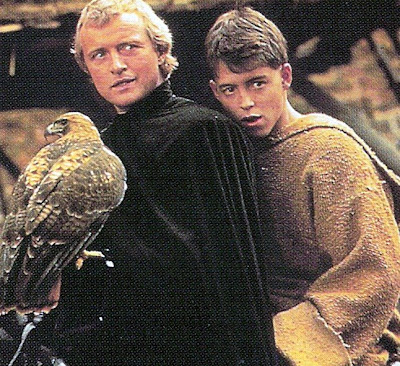
"Ladyhawke" = Medieval 'Ferris Bueller' - Valerie Fliss

In class we discussed the differences between monologues and dialogues; when I hear of monologues, I think of slightly egotistic people going on rants about themselves. When it comes to art, a dialogue seems like it would be more appropriate than a monologue, but what happens when the monologue turns into a dialogue through art?

"Ferris Bueller's Day Off" features a pretty interesting narrative structure, since the character, Matthew Broderick, is given some interesting monologues that function as a sort of dialogue with the audience. The audience may never speak to Ferris, and so when he speaks, his internal feelings at best are a sort of as rumination for himself.

However, there is another movie where Matthew Broderick does a similar narration, where he speaks out his internal thoughts; but in the movie "Ladyhawke", he is not addressing the audience, per se, but rather God. Broderick plays Philipe 'The Mouse' Gaston, a thief who must help a cursed knight and his lady-love break the awful spell placed upon them by a jealous bishop during the Middle Ages.

Like in 'Ferris Bueller', Broderick's character speaks to the camera, but instead of directing his personal comments to whoever might be listening, instead he does it for God. In looking towards himself, Philipe finds God, and then the film portrays this monologic prayer as a dialogue, demonstrating not only how prayer can transform what may seem as a monologue into a dialogue, but how art can speak out to us, and us through it then.

The Statue in the Park - Valerie Fliss

The statue of the man and horse by the Lion’s bridge was a solid example of the sorts of things that we have been discussing in class.

Besides the apparent symbolism of the image, man controlling nature, the statue also made me think about this idea that ritual/art is the space between impulse and reaction. In class, we discussed how this is the biggest difference between man’s creative efforts, and animals’ creative efforts; for animals, there is no space between impulse and reaction, but instead for man we have thought, and it is that thought that becomes art.

When one looks at the statue, then, the man is rearing in the horse’s impulse. He seeks to tame its impulses so that it will do as he wants. The man is not necessarily creating a space between the horse’s impulse and its reaction, but the man is acknowledging that there is no space, and he is able to acknowledge this because he could think about it. The man uses this space to control the horse, and in taming nature he is controlling his impulses, and the impulses of the nature itself.

So, the statue can be viewed as not only man’s triumph over nature, but also his own ability to create. In reining the horse/nature, man takes ahold of that space between impulse and reaction. And the statue is a physical reminder of that action of reining in the impulses and creating a reaction, instead of just reacting.

Sunday, November 15, 2009

Amy Jackson- Christian Art

In taking this class, Religion and the Arts, we explore the relationship between religion and art. We discover the beauty of art and the beauty of the divine. While reading "Sacred and Profane Beauty," Van der Leeuw says there is no "religious " art. Now when I read this I was, as you might be also, quite confused. I began to ponder the different types of art. Now I definitely have seen art that does not appear religious at all. In fact, there is
a lot of anti-religious art. Here's one for example:


Van der Leeuw goes on to quote Maritain by saying, "If you want to make Christian art, be Christians, and seek to make a beautiful work, in which your entire heart lies; do not try to make it Christian" (336). If art is imitation of God's creation, then this makes sense. However, if the artist is not a Christian, is the art still Christian? Does the intention behind the art effect the way people view it? Lets say that a non-religious person creates a beautiful landscape painting. Is this Christian because it exhibits creation? What about a photograph?


Maritain also says, "Everywhere where art-whether Egyptian, Greek, or Chinese-has attained a certain level and a certain degree of purity, it is in expectation already Christian, because all spiritual radiance is the promise and image of the divine weighing out of the Gospel" (336). According to Maritain, the art, not the artist, is the deciding factor of "religious" art. True religious art is art that does not have to include symbols or common religious images in order to convey the divine.

Kevin Gontkovic - Nihongi

For this post, I’d like to talk about the creation myth from the Nihongi that I believe was read in class. The myth says that after several generations of gods being born, the best ones, Izanagi and Izanami, came into being. Izanagi was the male deity and Izanami was the female deity. The two of them thrust the heavenly spear into the vast ocean, and after moving it around in the ocean, they pulled it out. The brine that was on the tip of the spear fell back into the ocean and formed an island that would later become the main island of Japan. They descended upon the island and created a pillar in the center of the island. The male deity went around the left side of the pillar and the female deity went around the right side of the pillar. When they met each other again, the female deity spoke first, which made the male deity displeased. He says “I am a man, and by right should have spoken first…” (Aston 13). He goes on to say that it was very unlucky having the female speak first and that they had to do the ritual over again. After they meet again, the male deity speaks first and then they essentially have intercourse. Through this act, the rest of the islands of Japan were created.

This myth shows that there is a right order to go about this whole idea of world making. Even though they are deities, they cannot just create things all of a sudden. They had to perform the ritualized dance around the pillar, and then speak to each other in the proper order. In the cosmos, there always has to be a proper order of things or else it turns into chaos. The dance around the pillar and having the male deity speak first was very important because it did result in the successful birthing of the country of Japan. The dance around the pillar was more than likely a religious dance because the creation of the islands probably would not have been as successful if they two deities did not give themselves up to a higher power. If they did not lose themselves in the dance, then the ritual would not have been performed correctly and the islands would have been birthed wrong.

This whole ritual had to be done correctly and in the proper order or else the creation would have not occurred. It is rather interesting how the act of intercourse resulted in the creation of the other islands of Japan. It kind of makes sense because intercourse between humans can result in the creation of another human; so, islands being created as a result of two deities having intercourse is not completely out of the question. It was not explained in the myth but there probably was a proper order to the act of intercourse as well. The proper order of things must be maintained in order to the act of world making to occur. This myth raises many questions as to the relationship between the proper order of things and world making.

Reference: Aston, W.G. Nihongi: Chronicles of Japan from the Earliest Time to A.D. 697. Rutland: Charles E. Tuttle Company. 1972. 443 pages.

Kevin Gontkovic - Sacred and Profane

For this post, I’d like to talk about Mircea Eliade’s book, The Sacred & The Profane: The Nature of Religion, and how it ties in with this class. One part I find interesting in this book is when he talks about the difference between chaos and cosmos. He says, “One of the outstanding characteristics of traditional societies is the opposition that they assume between their inhabited territory and the unknown and indeterminate space that surrounds it” (29). The cosmos represents order, which would be the civilization that these people live in. The chaos represents everything that is not ordered, which would be the outside world to these people. Everything that is not in our world is considered to be apart of some “other world” that we cannot comprehend. This “other world” could be similar to the world that artists give themselves up to in order to turn their art into something sacred. In order to created religious art, no matter what form of art it is, the artist must give up their whole being to create this “other world” in his or her art.

Eliade also discusses the differences between sacred and profane time. Sacred time would involve events that are held in honor of the sacred, like festivals. Profane time is essentially when nonreligious acts are performed. He states the big difference when he says, “Every religious festival, any liturgical time, represents the reactualization of a sacred event that took place in a mythical past, ‘in the beginnning’” (69). Every sacred event tries to recreate an event that happened in the past, which is usually described in one of the society’s sacred myths. This is similar to how an artist tries to recreate something that occurred in the mythical past when he or she is creating a religious artifact. The artist attempts to create an artifact that can go back to a sacred time and recreate what occurred then. A good example of this is Da Vinci’s painting of the Last Supper. Da Vinci recreated the event that occurred in the mythical past where Jesus had his last meal with his apostles. By recreating the world described in this myth, Da Vinci’s painting is able to go back to the sacred time of this event. This painting became a religious artifact because Da Vinci gave up his being to go back to this moment in sacred time and recreate for all to witness.

In another chapter, Eliade discusses the relationship between religious man and nature. Religious man knows the sacredness of nature because he is aware that the gods created the cosmos. Eliade says, “The sky directly, ‘naturally’, reveals the infinite distance, the transcendence of the deity. The earth too is transparent; it presents itself as universal mother and nurse” (117). All of the aspects of nature show the different characteristics of the sacred. When we look at the sky, we see it go on infinitely, which is the same as the deity that created it. The deity that created the sky is not a finite being. The earth is considered a mother because many organisms are birthed from the earth. These organisms that are birthed directly from the earth are then used for sustenance by other organisms that were not directly birthed by the earth. Many artifacts try to recreate these aspects that are present in nature. The artists recreate different aspects of nature in order to recreate the different aspects of the deity that created nature. The artist has to become one with the divine in order to recreate the divine that is present in nature.

Reference: Eliade, Mircea. The Sacred & The Profane: The Nature of Religion. San Diego: Harcourt Brace Jovanovich, Publishers. 1957. 256 pages.

Kevin Gontkovic - Kami

For this post, I’d like to talk about the painting that can be found at the following link: http://fineartamerica.com/featured/god-gayle-etcheverry.html. This is a painting is entitled God, which is the rough translation of the Japanese characters in the upper-right-hand corner of the painting. The Japanese word for this is Kami, which is usually translated as god. Kami are hard to pin down and define in terms that we can understand, which is why I find this painting to be a good rendition of what Kami are. In the painting one should be able to make out different shapes and forms, but there is no way to tell what is the true form of the object being painted. This is true of Kami because each one has many different forms that it can appear in. Kami can appear in essentially any form they choose. When communicating with people that visit their shrine, Kami will usually take the form of an object like a mirror that is housed in the shrine.

The abstract nature of the painting really shows how formless the Kami are. One can see some shapes when looking at the painting but one cannot make really make out what exactly those forms are. One can try to describe the objects in the painting by comparing them to shapes and concepts that one has seen in one’s own experiences with the world. This does not completely describe what is going on in the painting because the painting, just like actual Kami, cannot be fully explained using human means. Kami are apart of the “other world” that one cannot connect to without first giving oneself up to a higher power. This artist must have done just that in order to recreate the world of the Kami. The painter must given herself completely to the Kami in order to participate in the “world making” that we discussed in class. She created a world that is outside of our own.

The Japanese people believe that Kami are essentially everywhere in the world. Anything could house a Kami, from inanimate objects like a stone to animals and even humans. The world of the Kami would be said to be “wholly other”, which would make it very much unknown to humans. Many people would see the unknown as very chaotic. Chaotic is a good way to describe this painting. Humans live in the cosmos, which is ordered civilization; so, it would make sense that humans would not be able to understand a world of chaos. The world of the Kami would be considered a world of chaos by humans, which is why the painting appears to be chaotic. People cannot describe a world of chaos, which is why people cannot describe the world created in this painting.

Kevin Gontkovic - Torii

For this post, I’d like to talk about the presentation on a very important piece of Japanese architecture: the Torii. I thought the presentation was well done and it explained some aspects of the Torii that showed how much of a connection to the sacred it really had. The Torii acts as kind of a gate for people to pass through to see the divine. It usually stands in front of a shrine that houses a kami, or god. The Torii is the entrance into sacred ground and one must take proper precautions before entering. One must be purified because the world outside the shrine has become profane. There are many rituals that one must go through to purify oneself before passing through the Torii. These usually involve washing one’s hands and rinsing out one’s mouth. This is probably because those are the parts of the body that come into contact with the profane the most. These rituals are usually done using purified water. Water is very important in Japanese culture because of its purification capabilities.

As was shown in the presentation, there are many types of Torii. The Torii for the imperial shrine in Isu is very different from other Torii because that shrine holds the most important kami for the Japanese people, Amaterasu. Amaterasu is the sun goddess and one of her descendants, according to a myth, becomes the emperor of Japan; so, every emperor after him has been considered a descendant of Amaterasu. Her shrine is truly sacred ground, which is probably why even the Torii had to be redesigned to be different from others. The imperial shrine is traditionally demolished and rebuilt every twenty years so everything is renewed.

I thought the idea of having several Torii in a row was a very interesting one. This idea that with each Torii one passes under, one is going deeper and deeper into the sacred. This probably requires one to purify oneself even more so than at a shrine with only one Torii. I also thought the one Torii that was shown out in the water to be a rather beautiful sight. This particular Torii seems to take the purification idea to another level. By being in the water, the Torii seems to be purified. This may say something about the sacred that lies beyond the Torii. The kami that resides in that shrine might be even more pure than the kami in other shrines, which is why even the Torii needs to be purified. I find the Torii to be a very interesting and beautiful aspect of Japanese architecture, and I really enjoyed the presentation on it.

Saturday, November 14, 2009

Amanda DeSalme- Music's Imagery


"'Pictorial art' is a convenient expression, though hardly a happy one. It is wrong to limit the power of representation to painting and sculpture, in the face of the fact that it belongs beyond doubt, as a major component of the other arts, such as dance and, above all, literature, and is actually lacking only in music." -Van der Leeuw, p. 155


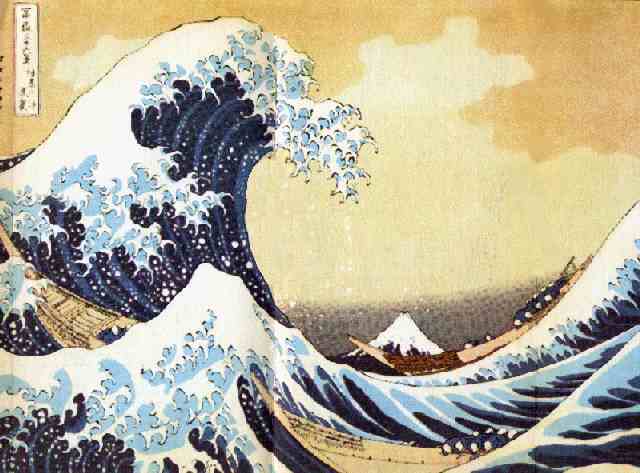
I disagree with this statement. Music uses imagery just as much as the other arts do. Claude Debussy for example spent all of his efforts in his compositions trying to find just the right "color" for the pieces he composed. When giving directions to a musical ensemble of any sort, tell them to play or sing while thinking "yellow" and then while thinking "red." You will get very different results. Have you ever listened to a piece of music while closing your eyes and pictured a story? There are so many timbres and ways to manipulate sounds that images just come into your head while you are listening. Sergei Prokofiev illustrated a story in "Peter and the Wolf," using different instruments to represent different animals. (the bird represented by a flute, the cat by a clarinet, the duck by an oboe, the grandfather by a bassoon, and so on.) Disney's movie Fantasia uses animation artists to recreate the imagery they imagine when listening to the classical pieces they chose to use. Music is connected to representation just as much as the other arts that Van der Leeuw mentions. I don't think he truly understands music as much as he does the other arts, because music is in no way lacking the element of representation. Listen to Debussy's "Nuages" and you will picture clouds floating in a summer sky. Music inspires "pictorial artists" to create, and vice versa. Debussy created his symphony "La Mer" because he was inspired by Japanese Artist Katsushika Hokusai's depiction of The Great Wave. (pictured above). This ability of music to create such images while listening to it is part of what makes it so powerful, and holy. We must not underestimate music's abilities. All of the arts are connected. The ocean can inspire a dance, a painting, a sculpture, architecture, a poem, a drama, and yes, a piece of music. All arts seek to represent things in a new light, sometimes coming across something very ethereal, awe-inspiring, and holy.

Amanda DeSalme- Silence in Music


I was reading Van der Leeuw's section on the Influences of music and religion, and came across an interesting statement. Van der Leeuw likens silence and near silence to darkness and semidarkness in architecture and the pictorial arts. (p. 236). I found it to be a great comparison between the different artforms. He also likens modulation and certain timbres and textures in music to light in the visual arts. Use of light and darkness is really affective at conveying a message, especially a holy one. When talking about silence, Van der Leeuw states that "It is not the silence of a man who has never spoken, but the falling silent in the presence of the holy- holding one's breath. For before the wholly other, one stands in silent reverence." (p. 236) This reminds me of some of my most spiritual experiences with music, where the use of silence in music can sometimes mean even more to the listener (or performer) than the actual pitches and sounds. It makes me think of "pregnant pauses" between phrases, or that moment of silence right when the song is over, before the audience explodes in applause. It is as if everyone in the room understands that something spiritual just happened and they fall silent in reverence before expressing their appreciation for the art that brought them closer to the wholly other. Silence makes music so beautiful. Van der Leeuw describes the sublime nature of music: "This overpowering can be fascinating or awe-inspiring. It can enchant, captivate, illuminate, remove a burden from the heart. It can also oppress, bring fear, cause horror and terror. Wherever the accent may lie, according to our working principle, no work of art can be an expression of the holy unless it contains both elements." (p. 232) Reading this section on music made me appreciate Van der Leeuw's interpretation more. I did not agree with him calling music "demolishing," but I agree with his detailed descriptions of the power of music in this section of his book.

The Grotesque - Valerie Fliss

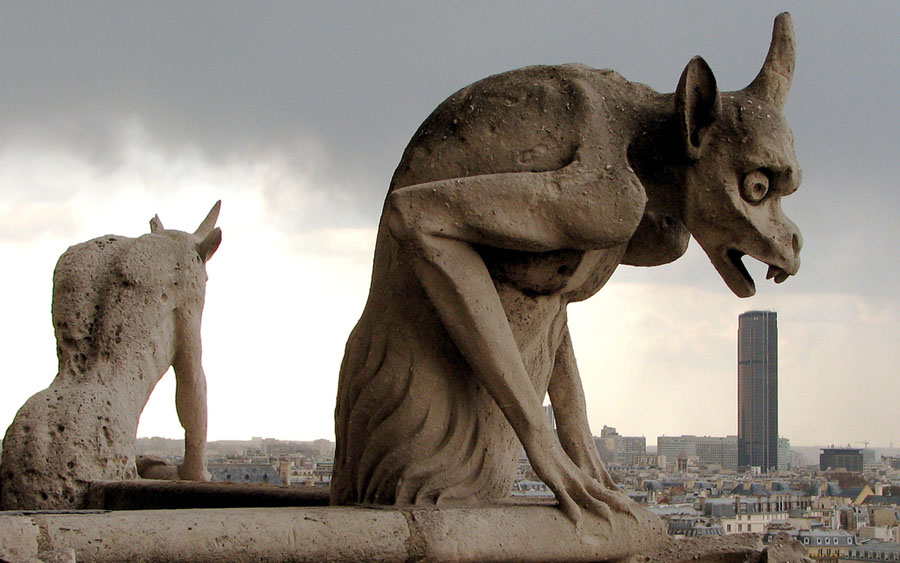
Flannery O'Connor, who was a participant in the Southern Gothic literature tradition, believed that the Gothic or the grotesque is what demonstrated the Divine best. And when you look at great Gothic cathedrals, with their rather horrid gargoyles and imposing spires, there is a great sense of fear and awe that comes over you. The tremulous awe that one gets from gazing at the grotesque is that same awe that, according Otto, one should experience from looking at art. Grotesque art might be one of the fastest ways to this experience of awe because it does make us step back in fear and horror.


Now, there is a difference between extreme horror and that awe that one gets - reading H.P. Lovecraft's stories about giant squid-headed gods that rise up from under the sea and destroy humanity is only going to give you nightmares if you take it too seriously. But that jolt that one gets from seeing something like a Gothic cathedral, or a picture of a monster in a storybook, or one of the characters from O'Connor's short stories, is going to take you out of your comfort zone for a minute, and make you see the world in a new light. It is going to make you a little frightened, but you will also be fascinated by it - this is how art can affect humanity, and bring it closer to the truth behind the world. Awe and fear is tied to fascination, and with fascination can come desire and longing, and desire and longing, if we listen to C.S. Lewis, are one step away from reaching the truth.

Domes - Valerie Fliss


I think domes are one of the most interesting architectural structures out there. For one thing, I can imagine that they are terribly difficult to build without the whole thing just collapsing in on itself once you are done. And for another thing, when you think about a building representing the universe, functioning as a microcosm, the dome is clearly an interpretation of the sky. It rises up into the air above the building, creating the sense of an atmosphere and grandness inside the building. It really functions as the sky of a building, because when you look at the sky outside, it appears to be rounded above you, like a shield from whatever lies beyond our world. Only the sun and the stars hint that there are things outside of the shield. The dome works in the same way - it shields from above, working to contain the universe and world within the building, completing the borders of the sacred space of a building. That is why I like domes.

Wednesday, November 11, 2009

It's Not 'Stardust'! - Valerie Fliss

My favorite kind of music is movie soundtracks - not songs that feature in movies, but the actually orchestrated score of the movies. I think that it comes from an early fascination with classical music, plus my social-life-destroying love for movies. I have the soundtracks for the movie "Stardust" and "Lady in the Water"; they are two of my favorites, and I play them so much that I've memorized them. My sister, however, cannot tell one movie theme from the other, and every time I put "Lady in the Water" on, she says, "Oh, wait, don't tell me - this is from 'Stardust', isn't it?"

Now, the two scores are done by totally different people, so I'm not sure what my sister's problem is, but I do find it interesting to get soundtracks done by the same composer from different movies. A good example is the composer Hans Zimmer - Mr. Zimmer has done tons of movies, from "Gladiator" and "Pirates of the Caribbean" to the "Lion King", "The Road to El Dorado" and even "Thelma and Louise." When you listen to these soundtracks, they are all different because they fit to different stories and genres, but at the same time, Mr. Zimmer has a very distinctive sound to him because of the key he chooses to write in, the instruments he favors, and the overall rhythms that he employs.

But if you think about it, all music is the same, essentially. How many times have you heard a piece of music and thought, "Hey, this reminds me of this other music…" Hans Zimmer has a distinctive flavor to all of his music because of how he hears the world - yet his music is similar to music from other genres, and those genres are similar to other genres…and it keeps going on until you wind up with one big mass of sound. All those distinctions disappear into the idea, the art of music - which ties into the idea of eschatology, or the idea of destruction. Music evaporates because it is only air, spirit, and all the individualism of the pieces of art called music disappear into one another. And so this is why I think Van der Leeuw's interpretation of music as belonging to the ideology of eschatology is appropriate. There is a disappearance of the individual within the art of music.

Dead Street - Valerie Fliss

A couple springs ago, my mother, sister and I went on vacation to Paris for a week. Besides the usual visits to the Louvre, Musee D'Orsay, and Versailles palace, one of my must-see attractions was the Pere Lachaise cemetery. I wanted to go and see the graves of Oscar Wilde and Moliere, and so my mom and I trekked out there to take a peek.

I remember feeling shivers of ghoulish delight when I saw the movie the "Mummy" and they talked about the "City of the Dead"; Pere Lachaise was literally a city of the dead. It took up about five city blocks, and there was just vault after vault, and grave after grave crammed into that cemetery. The funniest thing though, and my mother pointed it out, was that the vaults and mausoleums looked like little houses (some of them were quite elegant, with windows and fancy doors and even statues) lined along streets where people could walk along or cars could pull up onto. The vaults were houses for the dead, and then this cemetery was transformed into a city of the dead.


This makes me think of the house as a holy, sacred space. The house, as a sanctuary or representation of the world, is a place for the living, but the vault is the house, with the same connotations, for the dead. And just as a city is almost like a microcosm, a collection of homes gathered within boundaries, emulating the idea of the City of God, then a cemetery too emulates this because it is a collection of the houses of the dead. It is the reflection of the world after this world - the opposite of life.

Creepy, huh?