Monday, September 7, 2009

Longing and Art, the Saga in Old School TV


When thinking of art and longing, I immediately draw back to my childhood days when I waited anxiously to watch Boy Meets World and see what new challenge would unfold in relationship of Corey and Topanga.
In one episode, their relationship struggles revolved around this painting, a popular one by van Gogh. "Starry Night" is generally a picture of comfort, a portrait of beauty as many critics note.
Topanga went on a date with another boy and they both stared at this painting for hours, and in the painting she seemed to see the comfort and safety that she seemed to be lacking in her relationship with Corey. The boy she was on a date with agreed only because his longing was for her. Later, Topanga was seeking reassurance and brought Corey before this painting. He looked hard into the painting for a moment and he saw a battle. He saw God striking down the people in the poor town, and they didn't know what was coming to get them late in the night. His longing seemed to be one of a catharsis. He was seeking a purging of emotion so he and Topanga could resolve their issues and be reunited as the storybook couple that was always their lives.
This silly display is one to show that the comcept that is longing varies greatly from each individual, and we as humans are always looking for something we can take ourselfes. It is almost like self-confirmation bias. Our mood is going to influence what we receive from admiring the painting. Each perspective will be different, even if only a little bit, and each will create the longing as felt inside each individual.

Sunday, September 6, 2009

Sarah Bella Alderson-Art Sparks Longing

Writing Prompt: Art Sparks Longing

This lesson is most evident in music. As part of humanity, we are reminded of this everyday. Just circling through your ipod list, browsing your itunes for a song to play; we remember that art sparks longing. In this case, it's that song that you would love to listen to but can't because you miss him or her too much. It's the artist you skip completely because you don't want to think about what happened when you first hear it. That party you went to on Saturday night? It was the call or text that you made after hearing that song you both you used to listen to (and the regret that you feel this morning because of it).

Beware of delegating a song to a specific person. These days, songs last much longer than relationships. People seem to be more disposable than lyrics. Art lasts longer than reality.

As artists, we are in constant contact with all of our pasts: because we're the ones that are constantly confronting it, trying to better ourselves from the experiences we've had. As someone once said in a cheesey Hillary Duff movie: "Artists feel differently than others do." Teen flick aside, it's a true observation. I believe it's because we're more willing to feel pain than others (most often in search of those ecstatic feelings that are so rare).

It may be the romantic in me, but movies, television, and music inspire me to reconnect with others in a way that I haven't in long time. I long for the better times with those I have lost.

Valerie Fliss - DESIRE, Longing, and Art

Everything that I could have wanted to say about how desire can bring about joy was explained beautifully by Ms. DeSalme's post previous to this one, in her summary of C.S. Lewis' section in "Surprised by Joy" that discusses just that.

I think it is interesting, though, that when I hear the word 'desire', what comes to mind nowadays is the character in Neil Gaiman's graphic novel series "The Sandman". Mr. Gaiman personifies the idea of 'Desire' in the book, making it a a beautiful hermaphrodite (appears as either a man or a woman, depending on who's looking at it) who runs around and basically makes people desire things.

desirehughes6ms.jpg
^^Here be Desire as it appears in the "Sandman"!^^


Desire, in the 'Sandman', is not a necessarily good character, because once someone gets their desires granted through Desire, there is nothing left for them - their fire and energies burn out and they become this sort empty, shuffling person. In fact, Desire's twin sister is the horrendously ugly Despair - the two go hand and hand!

Mr. Gaiman's interpretation of 'desire' clashes with Mr. Lewis' explanation of 'desire', and I think that this is because they are two absolutely different things that must share the same word because the English language is a bit limited. Mr. Lewis's desire, the desire we talk about when discussing art, doesn't extinguish a fire when felt, but instead increases its intensities! Perhaps the difference in the desires comes in when you look at the orientation of desire: Mr. Gaiman's Desire is focused on the self and the senses, living out lusts and longings out of a desire just to be pleased, while Mr. Lewis' 'desire' comes out of a search for something else, looking for the even better, more beautiful thing or sense than what you are feeling at that moment - for Lewis, you are looking for the ULTIMATE sensation, the ULTIMATE thing.

By the by - I did not just decide to look at the 'Sandman' as a contrast to Mr. Lewis' idea of desire; I think that the storywriting and artwork of the whole "Sandman" series is awe-inspiringly beautiful - I always finish reading it with just a little bit of a heartache because I wish there was more.

Amanda DeSalme-Art and Longing

I was thinking about what was said in class on Wednesday about art and longing and decided to read more about what C.S. Lewis meant when talking about "Sehnsucht." From my understanding C.S. Lewis linked longing strangely enough to joy. I initially found this to be odd because Buddhists describe desire as the cause of all suffering, and strive to rid themselves of all desire. This makes sense in terms of tangible things, because objects are fleeting and cannot possibly make one truly happy eternally. But C.S. Lewis described a different kind of desire, a longing to come back to something transcendent that we can never really reach. He claimed that joy came through "blissful glimpses God sends to an estranged race to awaken sweet desire of pagans and thereby calling them to Himself."
C.S. Lewis also defined "joy" as the highest, purest sense of imagination, or a sense of awe at the realization of Absolute Truth. It is through art that humans try to convey this Absolute Truth, to awaken desire, to try with all our might to re-connect ourselves with that "Holy Other." As I reflect on Lewis' thoughts on these matters I recall emotions I have experienced when encountering beauty. Emotions that are so hard to put into words, poets and musicians and painters all try to communicate it and never really say it all. It is a constant longing that hurts in such a way that we feel joyous, to be coming into contact with anything at all. We feel a strange sense of ecstasy in knowing that we aren't quite there but we've got a blissful glimpse of it. I feel this way when moved by a particular piece of music, or witnessing a brilliant sunset, or coming across a poem that jars me into feeling something. And always afterwards there is the desire to have contact again. It is the reason I play a song over and over again, or read a poem again and again, or fumble for my camera to try and capture the radiant rays of the sun, still knowing that the picture won't suffice the next time around. The second listen of the song won't have quite as sweet of an effect on me as the first time I realized it had gripped me. The poem won't jar me as it did the first time. But I still feel joy in the quest to re-connect, to give the song another listen or to continue searching for more things to take me by surprise.

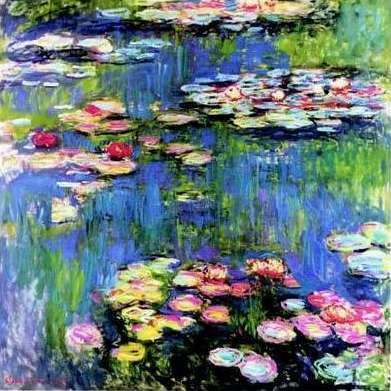
btw- I chose to put up an image of Claude Monet's "Water Lilies" simply because he was the first painter I was captivated by as a small child. I loved his lush scenes of bridges with flowers dripping from them and placid lily pads on a lake.

Saturday, September 5, 2009

Sarah Short - Perception of What is "Real"

Ever since our second class, I've been thinking a lot about the discussion we had regarding if there is one single reality for all of humanity or if everyone has their own valid reality. Or, beyond that, if most people's reality is valid, but not those who are deemed to be insane.

In my opinion, we're all crazy or unbalanced in our own unique way. But most of us pick a particular delusion to name "real" and those who disagree with us are labeled "crazy." If you think about, we use the word "crazy" all the time in our everyday lives to refer to someone's different perception of the same event. For instance, a couple breaks up. The girlfriend tells her friends her version of how the breakup occurred, which she believes to be accurate. The boyfriend tells his friends his altered version of the breakup, which he also believes to be accurate. But neither of them was able to step into the other person's being while the event occurred, and so they only obtained one understanding, one perception of the event. Thus, when each hears through the grapevine what the other has said about what happened, which differs from their own idea and memory, they will each automatically say, "They're crazy!"

But is it really accurate to call anyone crazy, even those with diagnosed, mental psychoses? Obviously, their perception of reality is different from ours, but does that make it inherently wrong? I would liken the perception of reality to the perception of art. The same painting hanging in a museum can be viewed by hundreds of thousands of people, and each individual is going to perceive a different image, intention, and meaning. To go further, no one seeing the painting will ever have the same perception of it as the creator of the piece. Is life not the same way? I see life differently, I find a different meaning in life, and I think differently about why life exists that the person next to me does, and the person next to him, and so on. Does that make me crazy? If I look at that painting and see love, and someone else sees hate, does that make one of us crazy? I think not. Each of us is basing our interpretation, our perception, off of past experiences and past knowledge. Past imitation even.

The question "what is art?" is then akin to the question of "what is reality?" No two people will have the same answer, but everyone's answer should be respected, and treated as an individual perception. Because for all we know, those whose perceptions are labeled as "crazy" or as "folly" may just be right in the end, if there can be a "right."

Kristine Penningroth-- Art: Impact and Harmony

After the class discussion on Wednesday I thought about the different things that we went over about how art can impact you and at what moment it grips you and draws you in and for what reasons. I always remeber hearing the phrase " Art is in the eye of the beholder", but I never really gave much thought to it. After talking more about this particular thought or opinion in class I have a different out look.

Art is a way of expressing an emotion, a feeling, whether is be happy, sad, mad, or any other emotion that a person is feeling. Art has a way of drawing people together or even just bringing one person to a different place mentally or spiritually. Art can mean so many different things to so many different people. It is about interpretation or in some cases just looking at a picture and just seeing beauty. When a person draws or writes or paints it is a way for him or her to release something that has been pent up inside them and this is the only way they are able to express themselves to the world and make themselves feel better. It creates a peace, or harmony in them. An Artist does this not only for himself, but also for those that will possibly look at his artwork and possibly be able to relate to what it is being expressed. The harmony that comes from a certain painting is left alone to the person to feel or not to feel. When the artwork is being produced there is a good possiblity that the artist was at peace when, or felt peace after the picture was finished. Other people when they go into a museum and look at the paintings feel the impact and harmonious feeling then. I have many times felt the artists message when looking at different pieces. It's an individual feeling that cannot be replicated.

Besides the harmony that can come with art, there is also an impact that can arise. Every person is different, but there are different pieces of artwork that do it for different people. The most important thing is what you feel after you have found your piece of art and how your life could change, or how your belief can change based on what you saw. There is some art that just makes you want to cry or some that is just so pretty to forget. It will be something that can come up in conversation so that you will want to share it and how you felt and what you wanted to take away from that experience once you had it. Another way of looking at the impact is taking the perspective of a small child. When I went to the Met the first time there was a painting of a lot of red, yellow, and orange stripes and specs. As a kid you really just look at it as pretty and colorful, but when I went back to the Met after I had grown up and learned more about history I found the painting again and it had a completely different meaning for me. It showed a conflict and how important and how strong it was. The colors were no longer just colors but figures expressing a time in history and feelings based on that time.

Art is so much more than just a pretty picture on the wall. The saying "A picture's worth a thousand words" is really true. The picture can bring so much more to light than a person trying to convey the meaning in words. It is an original way to express emotions that cannot be expressed in another way.

Wednesday, September 2, 2009

Valerie Fliss - Aristotle's Poetics and Comedy


I like laughing - there it is. You know those commericals for that website ComedyFetish.com? Yeah, well, if ever I had a fetish, it would have to be for comedy.

So, you can imagine that I was more than a little excited to read what Aristotle had to say about comedy, but after I read it, I'm not entirely sure if I liked it. For Aristotle, while Tragedy aims to represent men as 'better than in actual life', Comedy is meant to represent them 'as worse'! My thinking was always that Tragedy represented people as worse than they really are, while Comedy merely commented on how things were! Not, as Mr. Aristotle says, "consists of some defect or ugliness." How come Comedy is supposed to be a negative thing? And since when did Tragedy become all lofty!?

But, then I started to think about it in terms of 'imitation', and how imitation plays a role in Aristotle's view of art. Comedy is an imitation of the world, but an 'ugly' distortion - it takes the world, its people and ideas, and makes it base, lewd, and ludicrous so that we can laugh at it. It is this distortion that makes things seem so darn funny, and how the art of comedy comes about. It makes us look at the world in a different way, and realize, learn something about the world we live in. Overall, I think Comedy is supposed to show us (humanity, that is) not to take ourselves too seriously. Someone once told me (or I read it somewhere, which is just about the same thing as being told) that if humans couldn't laugh, we would have killed ourselves years ago because life would just have been too much for us to take. And while I may still have mixed feelings about Tragedy, in looking at the purpose of Comedy, making men look worse than they are so that we can laugh, the purpose of Tragedy making men look better than they are so that we can cry, seems to make much more sense. The participation in these dramas, in these imitations becomes an almost epiphany, an experience in that ultimate experience of what it is to be a human.

I have no particular reason for including that banana comic, except that I thought it was funny.