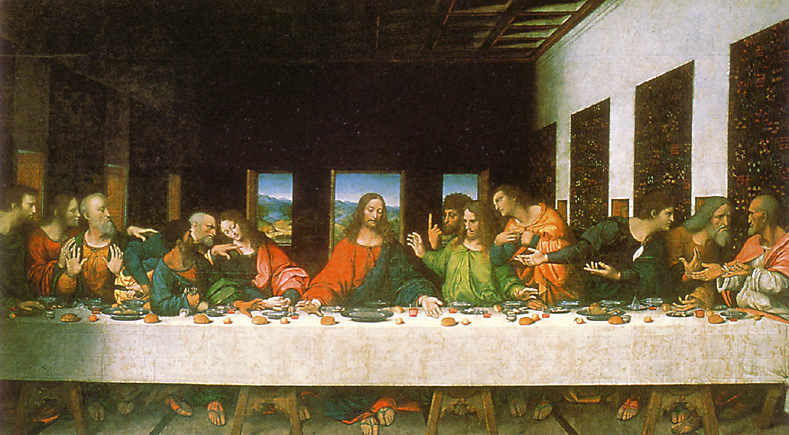
Over the summer I read "the DaVinci Code" by Dan Brown. I found it interesting to learn about the symbols in Leonardo DaVinci's work and the possible religious meaning behind them. In the novel, Robert Langdon and Sophie Neveu try to solve the mystery of curator Sauniere's death by following the symbols he left behind leading them to the works of DaVinci. Sauniere was a part of the secret society Priory of Sion, also known as the Knights of Templar, who are guardians of the Holy Grail. According to this novel, Jesus Christ was married to Mary Magdalene, who bore his child after he was crucified. I do not know about the historical accuracy of any of this, but it is interesting to speculate on the different possibilities of what went on in those times. In DaVinci's painting of the last supper, to Jesus' right is actually a female, said to be Mary Magdalene, instead of one of the 12 disciples. According to this novel, Mary is the Holy Grail, also called the chalice. A common symbol for the chalice, or "sacred feminine" is a V, whereas a symbol of a male would be inverted ^.
I also read the novel "Skinny Legs and All" by Tom Robbins over the summer, and found a connection to "the DaVinci Code" as it talked about the "sacred feminine." In this novel however, they are referring to the ancient Babylonian goddess Ishtar, the equivalent of Sumerian Astarte, and sometimes also connected to Aphrodite. In the novel there is a dancer who works at the restaurant that the story revolves around. (the restaurant, named "Isaac and Ishmael's" to celebrate the companionship of 2 men with different religions, was opened jointly by an Arab and a Jew). The dancer is coaxed into dancing the "Dance of the Seven Veils," which was originally danced by Salome (whose name is related to "Shalom"/peace) in the New Testament of the bible. It is a very erotic dance where the seven veils that are covering the dancer's body are removed one by one until she is dancing completely naked. When the dancer performed this dance in the novel, the main character, an artist named Ellen Cherry, had a sort of religious experience while watching the dance where truths were revealed to her, as if veils were being taken away.
Before I read these two novels, I never realized how common the theme of sacred femininity was before Western cultures paternalized everything. Nakedness was also very spiritual, whereas today it seems to be tied to "sin." What really opened my eyes though, was that there are so many different names for essentially the same goddess. (Ishtar, Astarte, Aphrodite, Venus). It makes me wonder how connected all of the religions of the world are. Maybe every religion is really describing the same thing and giving it different names.
Anyways, I highly recommend these 2 novels, and they talk quite a bit about religious art. They might open your eyes to whole new religious ideas through the beauty of the the work of art that is the novels themselves.
Today looking at the statue at the Lion's bridge we talked about how the image and sculpture before us could make us interact with it. Looking at the man taming the lion, each and every person was taken to a different time and place to bring them into their idea of where they think that the art could have come from. When I first looked at the statue I was thinking of a man in motion fighting with the powerful horse fighting for power over one another. In class a while back we talked about the flow, that is the distortion of time; or the mental state of operation when a person is fully immersed in focus on that activity. Looking at the statue for the first time I was fully immersed in focusing on the man and horse fighting for power against one another. The rhythm of the pulling back and forth between the horse and the man was what I could get from the statue, flowing side to side. Overall, the meaning of the statue that was the fight for power, and the man ultimately has the power in the world over everything. The man is the ultimate creature that rules the world, and even though there can be struggles in life and for power, man has all of the tools to be the most successful creature in the world. The four men that surrounded the statue each held a trade in their hands; each representing what man has the tools to do, improve and expand upon through. The struggle that the man is having with the horse is symbolic for the struggles that can be encountered through life. Looking at the statue today brought me to a specific place in time when I thought of a struggle, not with a horse, but in training my dog. I struggled with the power over my dog, as my dog was he was a puppy attempted to try to have power over me. So each peace of art brings you to a specific place and time where you can relate to the piece of art itself
I think it incredibly ironic that Michelangelo's statue of David is as huge as it is, because David was much, much smaller than Goliath, and with the statue it seems that the tables have turned. Humor aside, though, David is one considered one of the greatest pieces of art because, as according to Wikipedia, "it mimics divine creation". If you think about it, the creation of man was much like the creation of art that man does. And if man is the culmination of God's artistry, then that would explain why Michelangelo was so keen on sculpting the male body - he wanted to partake of a divine action.
I think that if there is one thing more powerful than experiencing art as a bystander, it is experiencing art within the creation process. Art can affect you after it has been finished, but I know from my own experience writing poetry and short stories, that the true joy of art comes with the creation of it. The thrill of putting things together, pulling things apart and watching something new arise beats just looking or reading an already prepared something by tenfold. Van der Leeuw classifies dance and theatre as being correlated with creation and God the Father, but I think that this does injustice to the fact that all art requires creation, and that there is that creation experience.
Have you ever wondered where the word 'art' comes from? Well, if you have nearly as much time on your hands and a good internet connection like I do, you might have.
"Art" comes from the Latin word "ars", which (according to Wikipedia) loosely translated means 'arrangement'. So art is merely some sort of arrangement, an organization or compilation of materials or things. But what sort of things are we arranging? Why the heck are we even compelled to arrange things? It comes down to this idea that we want to participate in 'world-creation'. And if you think about it this way, it seems rather blasphemous - that we, humans, would dare to create a world, a task that is usually relegated to the gods. But the Bible does say that man was created in the image and likeness of God, and is not part of that likeness the desire to create worlds? And since we have limited imaginations, wouldn't we try to build worlds based on the one that we live in? Is it not the Divine that reveals itself through our task of arranging and rearranging the world with different materials? Art, then, is the human compulsion to rearrange our world as we see it, and then share that view with others.
In class we discussed what religion is and one quote that stuck out to me was, "Religion is not an explanation of the world, that is science. Religion is a world." This quote shows the importance of religion in the world. If people wanted just an explanation of the world, there would be no worship. It would not be sacred. So many of the aspects of religion would not be necessary. People would not care to make art about it. Religion and science are very different in that understanding science is not vital to the eternal soul. If religion were to explain, without belief, there would be no faith.
The saying, "religion is a world" demonstrates that everything in life can be related back to religion. Whether good or bad, right or wrong, if it is part of the the world, it is part of religion. Does this make all art religious art? I would argue no because religious art is imitation of the holy, the divine. Not all art does this. Are rather the intentions behind the art what makes it religious?
Eating is fun, and I am sad to say that I am one of those people who doesn't really care what my food looks like, if I think it tastes good, I'm going to eat it and eat it quickly. This is sad because there seems to be a good deal of people who go through a lot of trouble to make food look like, well, art. Not only that, but there is a whole school of thought that beliefs the act of eating should be an artistic experience; isn't that what the word 'gourmet' relates to? A finer, dining experience? If music is an artistic hearing experience, image an artistic visual experience, and sculpture an artistic feeling experience, why can't food have an artistic tasting experience? The harmonious interaction of flavors can create an almost divine experience, don't you think? The culinary arts can be seen a world-creating, but focusing on the sense of taste instead of hearing or seeing (though the visual appearance of food can be artistic as well).
The other day I was driving with my sister in the car, and quite naturally we had the radio on. "Dancing with Myself" by Billy Idol came on, and since that is one of my favorite songs, I started to dance around in my seat, jerking my shoulders to the beat. My sister started to laugh at me, and when I asked her why she was laughing, she told me that she was envious that I could just start dancing as soon as I heard a beat, because apparently she can't.
Personally, I cannot prevent my body from reacting when I hear a beat, whether I tap my foot or a finger, go full out crazy with amazing arm action, or just adapt my breathing so that it goes along with the pulse. And it doesn't even have to be music -I remember seeing a movie where there was a slow-motion part with a helicopter hovering above the ground, and the sound of the copter wings thumping made my foot start to tap.
I think the thing to be envious of is dancing without a beat physically present, where you make up your own rhythm with the dance or tap into some unheard rhythm. This is what I think of when I read about primitive dance - the dance that creates rhythm, instead of completely reacting to it. That is what I think impressive dancing is, because it is a purer sort of dance. Unfortunately, our culture has dancing and music so tied together, it is near impossible for us to do this kind of dancing.