Sunday, November 15, 2009

Kevin Gontkovic - Torii

For this post, I’d like to talk about the presentation on a very important piece of Japanese architecture: the Torii. I thought the presentation was well done and it explained some aspects of the Torii that showed how much of a connection to the sacred it really had. The Torii acts as kind of a gate for people to pass through to see the divine. It usually stands in front of a shrine that houses a kami, or god. The Torii is the entrance into sacred ground and one must take proper precautions before entering. One must be purified because the world outside the shrine has become profane. There are many rituals that one must go through to purify oneself before passing through the Torii. These usually involve washing one’s hands and rinsing out one’s mouth. This is probably because those are the parts of the body that come into contact with the profane the most. These rituals are usually done using purified water. Water is very important in Japanese culture because of its purification capabilities.

As was shown in the presentation, there are many types of Torii. The Torii for the imperial shrine in Isu is very different from other Torii because that shrine holds the most important kami for the Japanese people, Amaterasu. Amaterasu is the sun goddess and one of her descendants, according to a myth, becomes the emperor of Japan; so, every emperor after him has been considered a descendant of Amaterasu. Her shrine is truly sacred ground, which is probably why even the Torii had to be redesigned to be different from others. The imperial shrine is traditionally demolished and rebuilt every twenty years so everything is renewed.

I thought the idea of having several Torii in a row was a very interesting one. This idea that with each Torii one passes under, one is going deeper and deeper into the sacred. This probably requires one to purify oneself even more so than at a shrine with only one Torii. I also thought the one Torii that was shown out in the water to be a rather beautiful sight. This particular Torii seems to take the purification idea to another level. By being in the water, the Torii seems to be purified. This may say something about the sacred that lies beyond the Torii. The kami that resides in that shrine might be even more pure than the kami in other shrines, which is why even the Torii needs to be purified. I find the Torii to be a very interesting and beautiful aspect of Japanese architecture, and I really enjoyed the presentation on it.

Saturday, November 14, 2009

Amanda DeSalme- Music's Imagery


"'Pictorial art' is a convenient expression, though hardly a happy one. It is wrong to limit the power of representation to painting and sculpture, in the face of the fact that it belongs beyond doubt, as a major component of the other arts, such as dance and, above all, literature, and is actually lacking only in music." -Van der Leeuw, p. 155


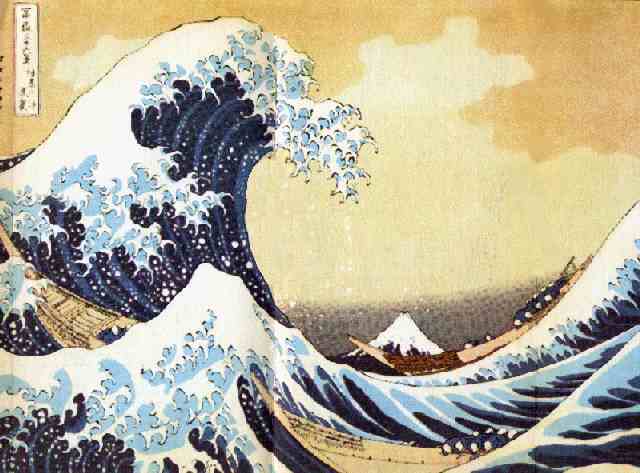
I disagree with this statement. Music uses imagery just as much as the other arts do. Claude Debussy for example spent all of his efforts in his compositions trying to find just the right "color" for the pieces he composed. When giving directions to a musical ensemble of any sort, tell them to play or sing while thinking "yellow" and then while thinking "red." You will get very different results. Have you ever listened to a piece of music while closing your eyes and pictured a story? There are so many timbres and ways to manipulate sounds that images just come into your head while you are listening. Sergei Prokofiev illustrated a story in "Peter and the Wolf," using different instruments to represent different animals. (the bird represented by a flute, the cat by a clarinet, the duck by an oboe, the grandfather by a bassoon, and so on.) Disney's movie Fantasia uses animation artists to recreate the imagery they imagine when listening to the classical pieces they chose to use. Music is connected to representation just as much as the other arts that Van der Leeuw mentions. I don't think he truly understands music as much as he does the other arts, because music is in no way lacking the element of representation. Listen to Debussy's "Nuages" and you will picture clouds floating in a summer sky. Music inspires "pictorial artists" to create, and vice versa. Debussy created his symphony "La Mer" because he was inspired by Japanese Artist Katsushika Hokusai's depiction of The Great Wave. (pictured above). This ability of music to create such images while listening to it is part of what makes it so powerful, and holy. We must not underestimate music's abilities. All of the arts are connected. The ocean can inspire a dance, a painting, a sculpture, architecture, a poem, a drama, and yes, a piece of music. All arts seek to represent things in a new light, sometimes coming across something very ethereal, awe-inspiring, and holy.

Amanda DeSalme- Silence in Music


I was reading Van der Leeuw's section on the Influences of music and religion, and came across an interesting statement. Van der Leeuw likens silence and near silence to darkness and semidarkness in architecture and the pictorial arts. (p. 236). I found it to be a great comparison between the different artforms. He also likens modulation and certain timbres and textures in music to light in the visual arts. Use of light and darkness is really affective at conveying a message, especially a holy one. When talking about silence, Van der Leeuw states that "It is not the silence of a man who has never spoken, but the falling silent in the presence of the holy- holding one's breath. For before the wholly other, one stands in silent reverence." (p. 236) This reminds me of some of my most spiritual experiences with music, where the use of silence in music can sometimes mean even more to the listener (or performer) than the actual pitches and sounds. It makes me think of "pregnant pauses" between phrases, or that moment of silence right when the song is over, before the audience explodes in applause. It is as if everyone in the room understands that something spiritual just happened and they fall silent in reverence before expressing their appreciation for the art that brought them closer to the wholly other. Silence makes music so beautiful. Van der Leeuw describes the sublime nature of music: "This overpowering can be fascinating or awe-inspiring. It can enchant, captivate, illuminate, remove a burden from the heart. It can also oppress, bring fear, cause horror and terror. Wherever the accent may lie, according to our working principle, no work of art can be an expression of the holy unless it contains both elements." (p. 232) Reading this section on music made me appreciate Van der Leeuw's interpretation more. I did not agree with him calling music "demolishing," but I agree with his detailed descriptions of the power of music in this section of his book.

The Grotesque - Valerie Fliss

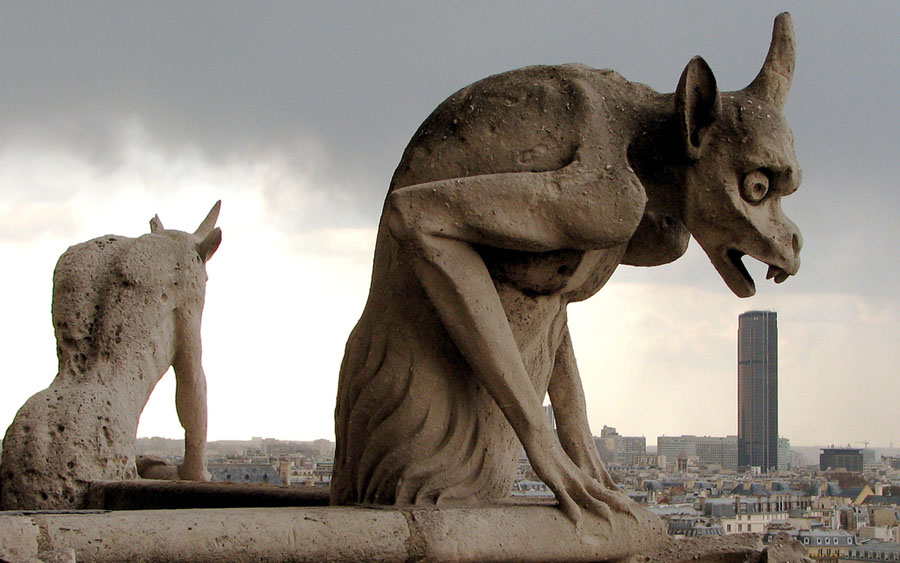
Flannery O'Connor, who was a participant in the Southern Gothic literature tradition, believed that the Gothic or the grotesque is what demonstrated the Divine best. And when you look at great Gothic cathedrals, with their rather horrid gargoyles and imposing spires, there is a great sense of fear and awe that comes over you. The tremulous awe that one gets from gazing at the grotesque is that same awe that, according Otto, one should experience from looking at art. Grotesque art might be one of the fastest ways to this experience of awe because it does make us step back in fear and horror.


Now, there is a difference between extreme horror and that awe that one gets - reading H.P. Lovecraft's stories about giant squid-headed gods that rise up from under the sea and destroy humanity is only going to give you nightmares if you take it too seriously. But that jolt that one gets from seeing something like a Gothic cathedral, or a picture of a monster in a storybook, or one of the characters from O'Connor's short stories, is going to take you out of your comfort zone for a minute, and make you see the world in a new light. It is going to make you a little frightened, but you will also be fascinated by it - this is how art can affect humanity, and bring it closer to the truth behind the world. Awe and fear is tied to fascination, and with fascination can come desire and longing, and desire and longing, if we listen to C.S. Lewis, are one step away from reaching the truth.

Domes - Valerie Fliss


I think domes are one of the most interesting architectural structures out there. For one thing, I can imagine that they are terribly difficult to build without the whole thing just collapsing in on itself once you are done. And for another thing, when you think about a building representing the universe, functioning as a microcosm, the dome is clearly an interpretation of the sky. It rises up into the air above the building, creating the sense of an atmosphere and grandness inside the building. It really functions as the sky of a building, because when you look at the sky outside, it appears to be rounded above you, like a shield from whatever lies beyond our world. Only the sun and the stars hint that there are things outside of the shield. The dome works in the same way - it shields from above, working to contain the universe and world within the building, completing the borders of the sacred space of a building. That is why I like domes.

Wednesday, November 11, 2009

It's Not 'Stardust'! - Valerie Fliss

My favorite kind of music is movie soundtracks - not songs that feature in movies, but the actually orchestrated score of the movies. I think that it comes from an early fascination with classical music, plus my social-life-destroying love for movies. I have the soundtracks for the movie "Stardust" and "Lady in the Water"; they are two of my favorites, and I play them so much that I've memorized them. My sister, however, cannot tell one movie theme from the other, and every time I put "Lady in the Water" on, she says, "Oh, wait, don't tell me - this is from 'Stardust', isn't it?"

Now, the two scores are done by totally different people, so I'm not sure what my sister's problem is, but I do find it interesting to get soundtracks done by the same composer from different movies. A good example is the composer Hans Zimmer - Mr. Zimmer has done tons of movies, from "Gladiator" and "Pirates of the Caribbean" to the "Lion King", "The Road to El Dorado" and even "Thelma and Louise." When you listen to these soundtracks, they are all different because they fit to different stories and genres, but at the same time, Mr. Zimmer has a very distinctive sound to him because of the key he chooses to write in, the instruments he favors, and the overall rhythms that he employs.

But if you think about it, all music is the same, essentially. How many times have you heard a piece of music and thought, "Hey, this reminds me of this other music…" Hans Zimmer has a distinctive flavor to all of his music because of how he hears the world - yet his music is similar to music from other genres, and those genres are similar to other genres…and it keeps going on until you wind up with one big mass of sound. All those distinctions disappear into the idea, the art of music - which ties into the idea of eschatology, or the idea of destruction. Music evaporates because it is only air, spirit, and all the individualism of the pieces of art called music disappear into one another. And so this is why I think Van der Leeuw's interpretation of music as belonging to the ideology of eschatology is appropriate. There is a disappearance of the individual within the art of music.

Dead Street - Valerie Fliss

A couple springs ago, my mother, sister and I went on vacation to Paris for a week. Besides the usual visits to the Louvre, Musee D'Orsay, and Versailles palace, one of my must-see attractions was the Pere Lachaise cemetery. I wanted to go and see the graves of Oscar Wilde and Moliere, and so my mom and I trekked out there to take a peek.

I remember feeling shivers of ghoulish delight when I saw the movie the "Mummy" and they talked about the "City of the Dead"; Pere Lachaise was literally a city of the dead. It took up about five city blocks, and there was just vault after vault, and grave after grave crammed into that cemetery. The funniest thing though, and my mother pointed it out, was that the vaults and mausoleums looked like little houses (some of them were quite elegant, with windows and fancy doors and even statues) lined along streets where people could walk along or cars could pull up onto. The vaults were houses for the dead, and then this cemetery was transformed into a city of the dead.


This makes me think of the house as a holy, sacred space. The house, as a sanctuary or representation of the world, is a place for the living, but the vault is the house, with the same connotations, for the dead. And just as a city is almost like a microcosm, a collection of homes gathered within boundaries, emulating the idea of the City of God, then a cemetery too emulates this because it is a collection of the houses of the dead. It is the reflection of the world after this world - the opposite of life.

Creepy, huh?